
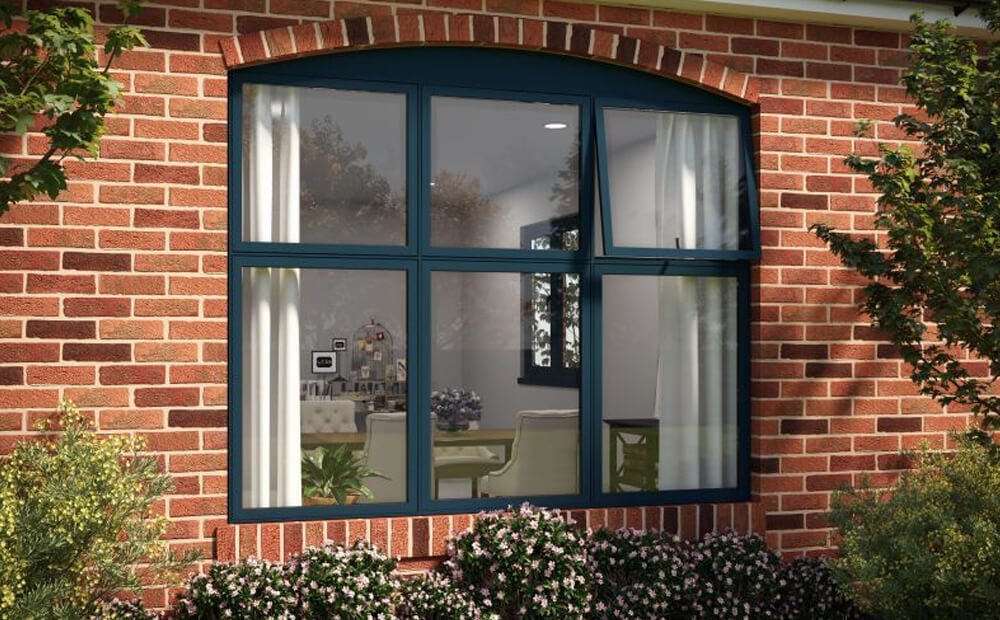
Fixed Secondary Glazing
A permanently glazed panel in a slim frame, with no opening leaf at all. The highest performing option acoustically, and the one with the strictest rules attached.
How it operates
It does not, and that is the point. The glass is bedded into a fixed frame on a continuous gasket with no meeting stiles, no brush seals and no gaps at all. Every openable system loses a little performance at the joints between moving parts. A fixed panel has none, so for a given glass thickness and cavity it will always outperform a slider or a hinged unit on both noise and heat loss.
What it suits
Openings that genuinely never need to open and are not the room's ventilation or escape route: fanlights and toplights above doors, stairwell and gable glazing, decorative or stained glass panels being protected, plant rooms, corridors, and studio or music room walls where the acoustic target is the whole reason for the job.
- Fanlights, toplights and stairwell glazing
- Protecting stained and leaded glass
- Studios and acoustically critical rooms
- Commercial corridors and plant areas
How it is fitted
Templated exactly like every other system, manufactured to the template, then fixed into the reveal, levelled, glazed and perimeter sealed. Because there is no running gear or hinge, a fixed unit can be made to almost any shape and to sight lines slimmer than any openable equivalent, which is often the reason a conservation officer prefers it on a decorative window.
Cleaning and access to the original window
This is the trade off. The panel can be de-glazed and the frame unscrewed, but that is a job for an installer, not a Saturday morning. Before specifying fixed, we agree honestly whether the original window will ever need painting, repair or opening. If there is real doubt, we fit a lift out panel instead: it seals nearly as well and comes out by hand.
- Cavity is sealed and stays clean for years
- Original window not accessible without removal
- Consider lift out if the primary needs repainting
- We record the frame fixings for future removal
Ventilation and escape, the rules that matter
A fixed panel must never be the only thing over a designated fire escape window, and it must not remove a habitable room's background ventilation. Where the primary window carried a trickle vent, we either build an equivalent vent into the fixed frame or confirm alternative ventilation exists in the room. Sealing a bedroom or bathroom completely tends to move condensation onto a colder surface elsewhere rather than curing it.
Where it is the wrong choice
Any bedroom escape window, any window used to air a room, any primary window with failing paintwork or rot that will need work soon, and any opening a homeowner expects to reach through. In all of those a lift out, hinged or sliding unit is the correct product even though the numbers on paper are marginally lower.
Frequently asked questions
Yes, marginally but consistently, because there are no moving joints to leak. Cavity depth and glass specification still matter more than the frame type.
Specify a fixed panel properly
Tell us the room, the window and whether it ever opens. We will confirm whether fixed is safe here or recommend a lift out.